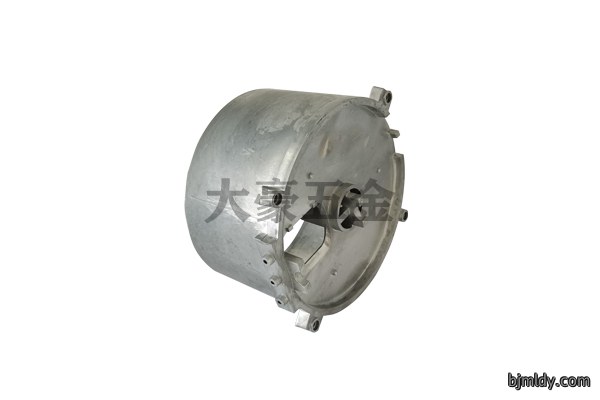
Die-cast aluminum alloys represent a category of metallic materials characterized by high specific strength—meaning they deliver substantial load-bearing capacity relative to their weight—alongside exceptional corrosion resistance properties that enable extended service life in demanding environments, combined with superior electrical and thermal conductivity that makes them indispensable in applications requiring heat dissipation or electrical functionality, comprehensive casting capabilities that permit intricate geometry production, and extensive processing functions allowing secondary machining and finishing operations to achieve precise tolerances and surface quality requirements; consequently these materials have become deeply embedded across automotive manufacturing where engine blocks and transmission housings demand lightweight solutions, telecommunications infrastructure where signal transmission components require optimal electrical properties, consumer electronics encompassing everything from smartphone housings to laptop chassis that necessitate both thermal management and aesthetic finish, and aerospace sectors where weight reduction directly correlates with fuel efficiency and performance specifications.
Die cast aluminum alloy represents a category of metal materials engineered through pres
In addition to confirming smooth die-casting processes and satisfying the functional working requirements of the manufactured accessories within industrial production, the die-cast aluminum alloy material must simultaneously demonstrate several addi
When the superheat temperature remains within a moderate range, or even approaches the transition zone between solid and liquidus temperature boundaries where material properties shift fundamentally, the metal melt must demonstrate robust plastic body rheology characteristics that enable it to effectively penetrate and fill intricate cavity geometries without entrapment of gases
Within the domain of precision casting processes, maintaining a modest line shortening rate during solidification represents a critical parameter for quality control.
The crystallization temperature range is small, which serves to reduce the possibility of shortening the generation of holes in the casting, a phenomenon that occurs when molten metal sol
The material demonstrates adequate high temperature return strength, a critical property that functions to prevent deformation or cracking of castings during the mold opening phase,
Within the context of die casting operations, the adhesive formulation demonstrates a notable characteristic wherein no chemical reaction occurs between the compound and the die casting mold surface, while simultaneously maintaining minimal affinity
Within the specialized field of die casting operations, maintaining adequate thermal conditions throughout extended production cycles presents a significant engineering challenge that requires careful material science consideration.